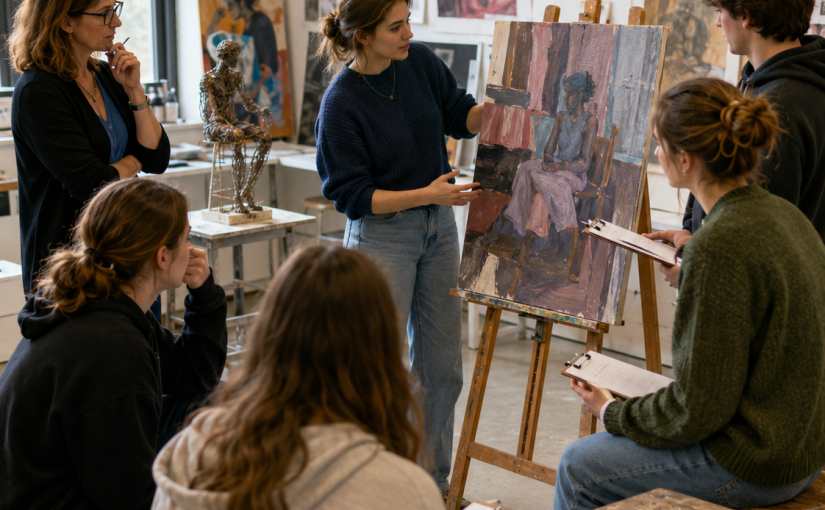
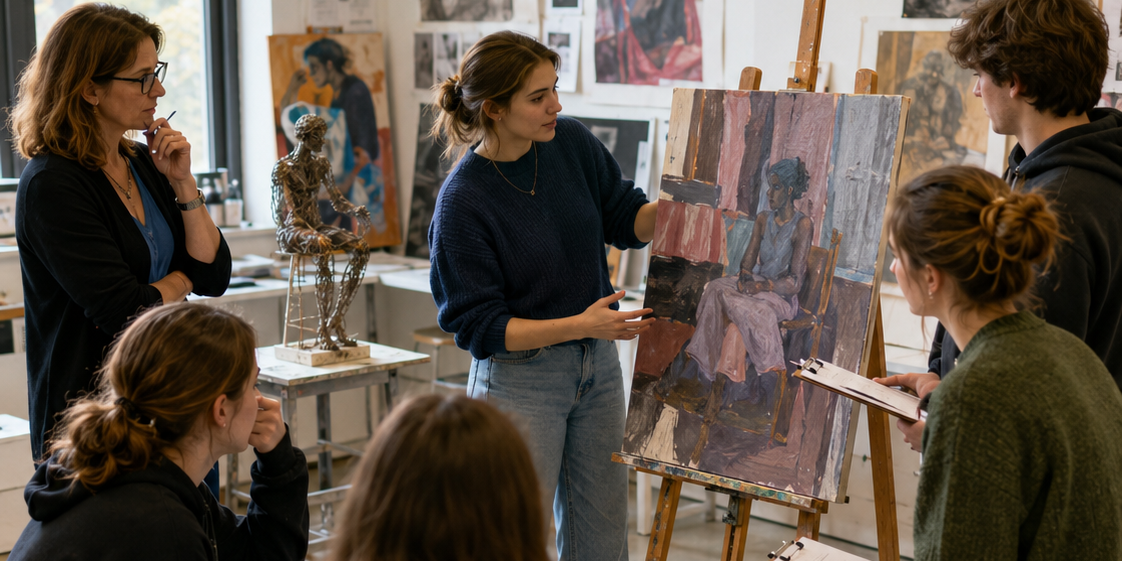
When I was an art student, I loved critique sessions. There was something exciting about putting work in front of other artists and hearing what they genuinely noticed, questioned or responded to.
Now, teaching A-level and IB Visual Arts, I think critique is one of the most important habits we can develop with students — particularly in the second year, when time suddenly becomes very precious.
In my classroom, we have a regular critique towards the end of the week.
Students bring either a finished artwork or something currently in development. But they also need to bring a question.
What are you trying to communicate?
What are you unsure about?
Is the intention coming through?
Does this material, composition or process actually support the idea?
That changes critique from “Do you like my artwork?” into a much more useful conversation.
Students also need the vocabulary to participate. If they don’t yet know how to discuss artwork, we can’t simply expect them to magically become good critics. I use prompts around formal elements, intention, materials, composition and viewer response to help build that language.
One thing that has completely changed this process for me is recording the critique using Voice Memos.
Not because I particularly want to listen to an hour-long recording again — but because I want the transcript.
Afterwards, I can take that transcript into ChatGPT and organise the discussion into clear feedback:
- What people noticed
- Questions that were raised
- What appears to be working
- What is unclear
- Most importantly: next steps
Suddenly, a conversation that could easily disappear at the end of the lesson becomes evidence of development.
Students can add the notes to their sketchbook or IB inquiry documentation, photograph the artwork as it currently looks, and then return to it the following week.
Artwork → critique → reflection → change → photograph → critique again.
For me, that is where critique becomes really valuable.
It also creates accountability.
Students know they need something to bring to the conversation. They know their intentions may be questioned. They know that next week we will look again and ask: What changed?
Because these courses aren’t ten years long.
Time matters.
And sometimes one of the most useful things we can teach young artists is not simply how to make work — but how to talk about it, listen to others, question it and then act on what they discover.