Student agency is something we talk about frequently in education, but in Visual Art it can be more complicated than simply allowing students to choose their own subject matter or materials.
For some students, Art is an intimidating subject. They arrive with a firmly established belief that they are either good at art or they are not. They compare their work with other students’ work, worry about drawing something incorrectly, and can become so focused on what the finished artwork will look like that experimentation begins to feel risky.
This is why I increasingly see the sketchbook as one of the most important places for developing student agency.
A sketchbook should gradually become the student’s space, rather than simply a book created to complete teacher-directed tasks.
Of course, students need structure. They need to learn how to research, document processes, organise information, investigate artists and communicate their intentions. Developing those organisational skills is an important part of learning how to work independently.
But within that structure, there should gradually be more room for ownership.
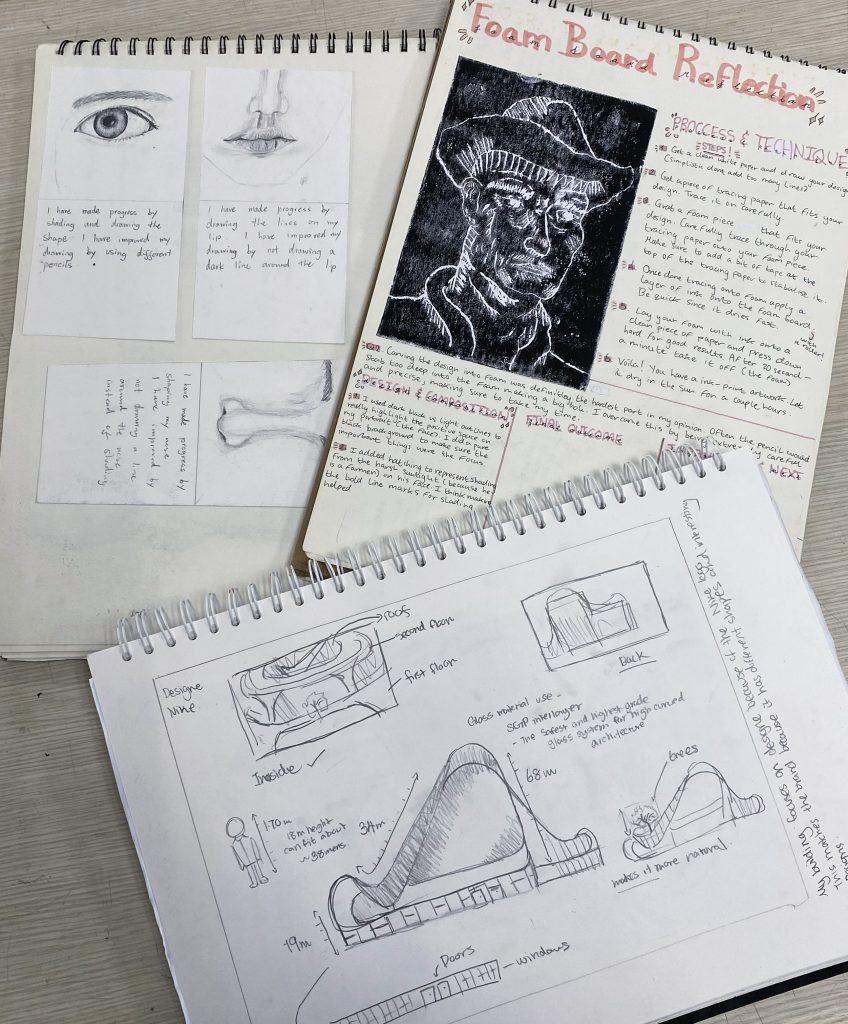
Students can begin deciding how to organise a page, which images are important, what they want to investigate further, how to annotate their thinking, and which experiments deserve another attempt. Their own photographs, drawings, observations, language, cultural references, memories and unfinished thoughts can begin to enter the sketchbook.
When this happens, something interesting begins to change.
The sketchbook becomes less about producing a sequence of perfect pages and more about making thinking visible.
And that means there has to be room for mistakes.
Art education can sometimes unintentionally reinforce the idea that success is represented by a beautiful final artwork. Yet much of the most valuable learning happens long before the resolved piece appears.
A drawing might fail.
A composition might feel awkward.
A material may not behave as expected.
An idea might need to be abandoned completely.
Rather than removing these moments from the sketchbook, students can learn to document them, reflect on them and recognise how they influenced the next decision.
For a student who doesn’t initially see themselves as artistic, this can be particularly powerful. The pressure to continually prove that they can make a successful artwork begins to lessen. Instead of judging themselves by a single finished outcome, they can look back through their sketchbook and see physical evidence of progress.
A hesitant drawing develops into a more confident one.
A simple idea becomes more complex.
A failed experiment leads to another experiment.
An artist reference sparks an unexpected direction.
Gradually, students start to recognise that progress in Art does not necessarily mean becoming perfect. It means becoming more observant, more curious, more willing to experiment and increasingly able to make and explain their own creative decisions.
Perhaps one of the clearest signs of agency is when students stop constantly asking:
“Is this right?”
and begin asking:
“What if I tried this?”
Their sketchbooks start looking less like one another. Their individual voices become clearer. They revisit earlier ideas, make connections independently and become more comfortable changing direction.
For me, this is an important part of what student agency can look like in Visual Art.
It isn’t simply freedom or choice.
It provides students with enough structure to develop confidence, then gradually allows them to take responsibility for the creative process.
The finished artwork still matters.
But increasingly, students understand that it is only one part of a much bigger journey — one that includes questioning, experimenting, organising, reflecting, making mistakes and trying again.
The goal is not simply for students to make better artwork. It is for them to begin seeing themselves as people capable of having ideas, making creative decisions and owning the process that gets them there.